Does Creatine Damage the Kidneys? What the Evidence Really Says
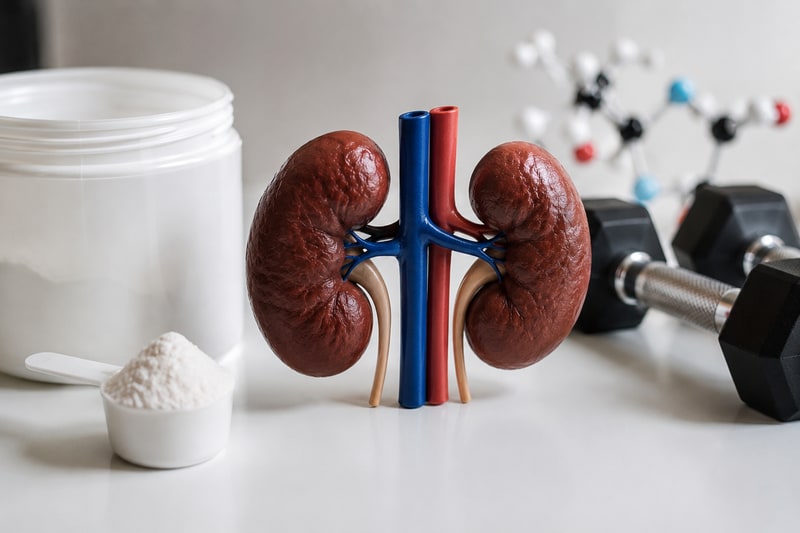
What is creatine?
Creatine is a naturally occurring compound that the body produces and uses to generate immediate energy during short, high-intensity efforts. Around 95% of it is stored in skeletal muscle as phosphocreatine, an energy reserve that helps regenerate ATP, the body’s primary energy source.
We obtain creatine in two ways: through our diet, mainly from meat and fish, and through endogenous synthesis, primarily in the liver and kidneys. Everyone produces creatine naturally. Supplementation simply increases the amount stored in muscle, which may improve physical performance, particularly when combined with resistance training.
Creatine and creatinine: the source of the confusion
A large part of the confusion stems from the similarity between two words that do not mean the same thing. Creatine plays a key role in muscle energy production. Creatinine, on the other hand, is a waste product generated when a small proportion of creatine is broken down each day and is subsequently eliminated by the kidneys. For this reason, creatinine is used as an indirect marker of kidney function: when the kidneys filter less efficiently, creatinine tends to accumulate in the blood.
This is the key point. When a person takes creatine supplements, more creatine is available to be converted into creatinine, so blood creatinine levels may rise slightly even though kidney function remains completely unchanged. As a result, a blood test may show a higher creatinine concentration despite the absence of any actual kidney damage. Because many equations used to estimate glomerular filtration rate (eGFR) are based on serum creatinine, the calculated eGFR may appear lower than it truly is.
Is creatine supplementation safe?
Creatine monohydrate is probably the most extensively studied sports supplement available. In healthy individuals, it has an excellent safety profile when consumed at recommended doses.
There are two common supplementation strategies. One involves a loading phase of approximately 20 g per day, divided into several doses for 5–7 days, followed by a maintenance dose of 3–5 g daily. The alternative is to start directly with 3 g daily without a loading phase. Muscle creatine stores increase more gradually, but the final level of saturation is essentially the same.
At these doses, long-term studies have not demonstrated harmful effects on kidney function in healthy individuals. When side effects occur, they are generally limited to mild gastrointestinal discomfort, particularly if large doses are taken at once.
Does creatine damage the kidneys?
The meta-analyses published in recent years are consistent: creatine supplementation slightly increases serum creatinine, but it does not demonstrate a decline in kidney function when this is assessed using methods that do not rely on creatinine itself. The increase occurs because more creatine is available to be converted into creatinine, not because the kidneys are functioning less effectively. That said, an increase in creatinine should never be dismissed or interpreted in isolation. It must always be evaluated within its appropriate clinical context.
What about people with chronic kidney disease?
Here, the evidence is different. Most clinical trials have been conducted in healthy individuals or athletes, while studies in people with chronic kidney disease are limited and generally involve short follow-up periods. This is precisely what has changed in recent years: the KDIGO 2024 Clinical Practice Guideline recommends reviewing the use of dietary supplements in patients with chronic kidney disease and avoiding those that may be potentially harmful. Among these, creatine is mentioned because of a small number of isolated case reports of acute interstitial nephritis, although these reports have important methodological limitations and do not establish a causal relationship.
For this reason, routine creatine supplementation is not recommended in patients with advanced chronic kidney disease (CKD stages G4–G5) unless it is prescribed and monitored by a healthcare professional.
The other side of the story is that the kidneys themselves are involved in creatine synthesis, and endogenous creatine production may decline as kidney disease progresses. In addition, patients undergoing hemodialysis lose creatine during each dialysis session. Several small studies in individuals receiving hemodialysis have reported improvements in muscle mass, functional capacity, and muscle cramps without significant safety concerns. However, the current evidence remains insufficient to support a general recommendation for creatine supplementation in this population.
How should kidney function be assessed in people taking creatine?
Creatinine depends on kidney filtration, but it is also influenced by muscle mass and creatine supplementation. When there is uncertainty, cystatin C, a protein filtered by the kidneys that is independent of both muscle mass and creatine supplementation, provides a more reliable estimate of kidney function, and many clinical guidelines recommend combining it with creatinine.
In selected cases, glomerular filtration rate (GFR) can also be measured directly using exogenous filtration markers. In any case, kidney function should never be interpreted on the basis of a single laboratory value alone. Previous laboratory results, estimated glomerular filtration rate (eGFR), albuminuria, urine sediment, and blood pressure are all essential components of a proper clinical assessment.
What can you do today?
- If you are healthy, the usual dose of 3–5 g of creatine monohydrate daily has a strong body of evidence supporting its safety.
- Choose products from reputable manufacturers.
- If your creatinine level increases while taking creatine, do not panic. Discuss the result with your physician before drawing conclusions.
- If you have chronic kidney disease, consult your nephrologist before starting supplementation. Current recommendations advise against routine use unless specifically indicated.
- If you are pregnant, breastfeeding or receiving treatments that require close kidney monitoring, seek medical advice before taking creatine.
My perspective as a nephrologist
I often see the same situation in my clinic: someone looks at their blood test results, notices that their creatinine level is flagged as abnormal, and immediately assumes the worst. It is an understandable reaction.
But one of the most important lessons nephrology has taught me is that a single number, taken out of context, never tells the whole story.
Creatine is no exception. As with so many topics in medicine, the answer is rarely a simple yes or no. In healthy individuals who exercise regularly, the available evidence is generally reassuring. In people with advanced chronic kidney disease, however, a more cautious approach is appropriate—not because of dogma, but because we still lack sufficient high-quality evidence.
Perhaps the greatest value of this discussion is that it reminds us not to stop at the headline. Instead, we should always ask what lies behind each laboratory value before drawing conclusions.
One-minute summary
- Creatine has not been shown to damage the kidneys in healthy individuals.
- It may cause a small increase in serum creatinine without reflecting actual kidney damage.
- Creatine and creatinine are different substances despite their similar names.
- In advanced chronic kidney disease, routine supplementation is currently not recommended unless medically supervised.
- When laboratory results are unclear, cystatin C can provide a more accurate assessment of kidney function.
Frequently Asked Questions
Does creatine always increase creatinine?
Many people experience a small increase, but not everyone, and the magnitude varies. An increase does not necessarily indicate kidney damage.
Can I take creatine if my kidney function is borderline?
It depends on the degree of kidney impairment. This decision should be made together with your nephrologist.
What is the difference between creatine and creatinine?
Creatine is the compound muscles use to produce energy. Creatinine is the waste product generated when creatine is naturally broken down.
Should I stop taking creatine if my creatinine is high?
Not based on that result alone. The finding should always be interpreted within the context of your complete clinical assessment.
Does creatine benefit patients on dialysis?
Some small studies suggest improvements in muscle mass and muscle cramps, but the evidence is still insufficient to recommend routine supplementation.
References
- Naeini EK, Eskandari M, Mortazavi M, Gholaminejad A, Karevan N. Effect of creatine supplementation on kidney function: a systematic review and meta-analysis. BMC Nephrol. 2025;26:622. doi:10.1186/s12882-025-04558-6.
- Kreider RB, Kalman DS, Antonio J, Ziegenfuss TN, Wildman R, Collins R, et al. International Society of Sports Nutrition position stand: safety and efficacy of creatine supplementation in exercise, sport, and medicine. J Int Soc Sports Nutr. 2017;14(1):18.
- Arenas Jiménez MD. Cuando el deporte deja de ser salud: dietas, suplementos y sustancias para aumentar el rendimiento y su relación con el riñón. Nefrología. 2019;39(3):223-226. doi:10.1016/j.nefro.2018.10.004.
- Tsiaras A, Loufopoulos G, Theodoridis X, Liakopoulos V, Poulia KA, Chourdakis M. The effect of creatine supplementation on kidney function: a systematic review and meta-analysis of randomized controlled trials. J Ren Nutr. 2026. doi:10.1053/j.jrn.2026.04.010.
- Almeida AS, Silva LOD, Takahasi BNA, Terada BD, Gonçalves FGA, Porto BC, et al. Impact of creatine supplementation on kidney health: a systematic review and meta-analysis. Int Urol Nephrol. 2026.
Is there a supplement you’d like me to cover in a future article?
You can suggest a topic through the contact form, and I’ll explore it based on the scientific evidence.
Is there a topic you'd like me to cover? Suggest an article
30 July 2026
Newsletter
Get new articles
Leave your email and we'll let you know when a new article is published. No spam; you can unsubscribe anytime.
✓ Almost there. We've sent you an email to confirm your subscription; please check your inbox (and spam folder).
An error occurred. Please try again later.